Test store. Nothing is charged: pay with card 4242 4242 4242 4242, any future date, any CVC.
Lifestyle and Activity
The Athlete's Spine
How kicking, running and squats load the spine
$59
- Free shipping on 3 or more paper prints. Shipping is added at checkout.
- Printed to order for your office and shipped to US addresses.
About this poster
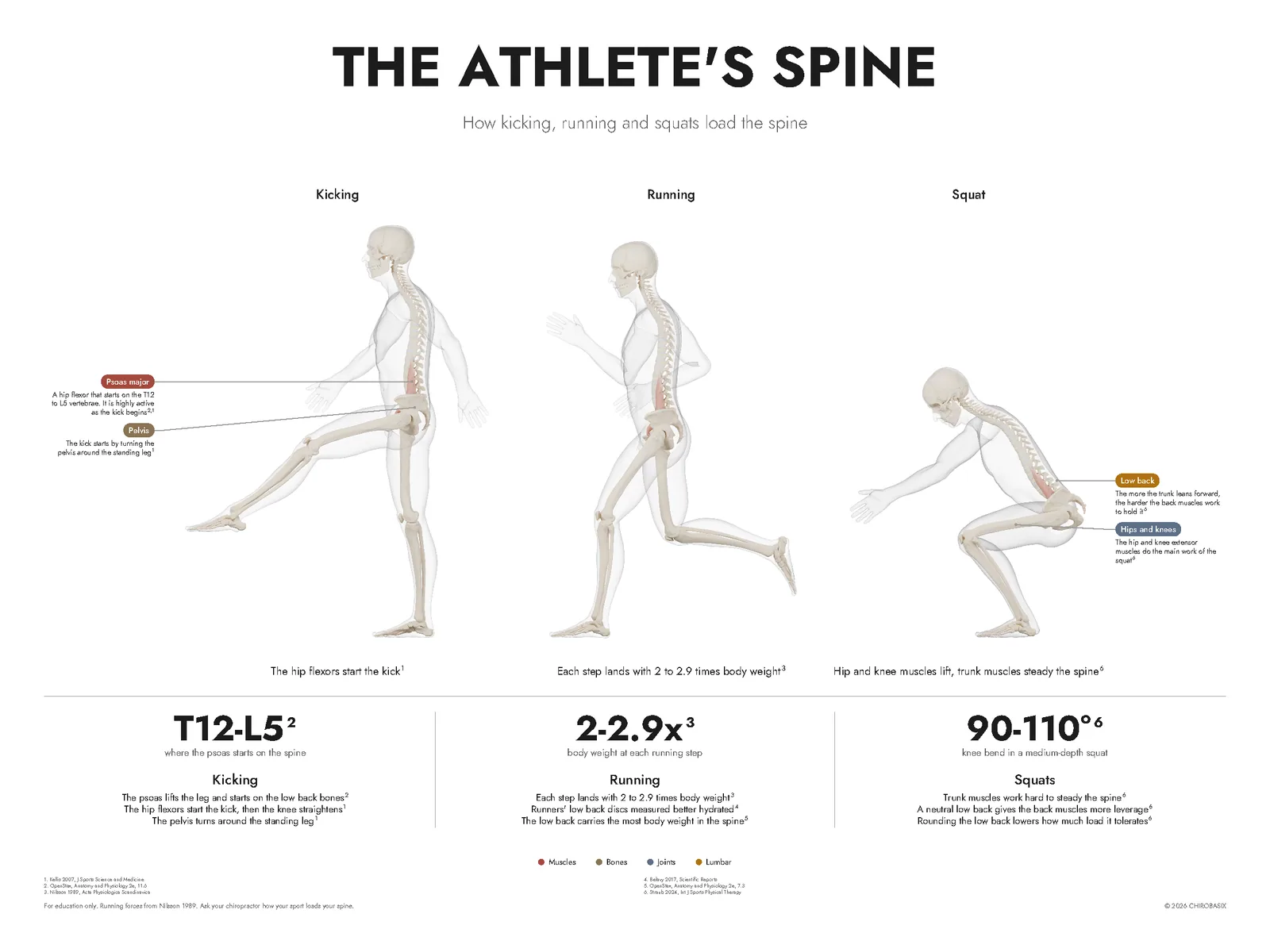
How kicking, running and squats load the spine. Side-by-side views: Kicking, Running, Squat.
Everyday posture and activity: driving, desks, lifting, running, golf.
What it shows
- Kicking
- Running
- Squat
Facts on the poster
- T12-L5 where the psoas starts on the spine
- 2-2.9x body weight at each running step
- 90-110° knee bend in a medium-depth squat
Printed on the poster: For education only. Running forces from Nilsson 1989. Ask your chiropractor how your sport loads your spine.
Print details
- Paper
- Museum-quality matte paper, 200 gsm (80 lb), printed with archival inks.
- Framed
- Ready to hang. Wood frame with a shatterproof acrylic front and the hanging hardware attached. Black, white, natural wood or dark wood.
- Shape
- Wide (landscape)
- Topics
- Spine and Back, Sports and Exercise
Sources (6)
- Kellis E, Katis A. Biomechanical characteristics and determinants of instep soccer kick. J Sports Sci Med 2007;6
- OpenStax, Anatomy and Physiology 2e, 11.6 Appendicular Muscles of the Pelvic Girdle and Lower Limbs: the psoas major originates in the lumbar vertebrae
- Nilsson J, Thorstensson A. Ground reaction forces at different speeds of human walking and running. Acta Physiol Scand 1989;136
- Belavy DL, Quittner MJ, Ridgers N, Ling Y, Connell D, Rantalainen T. Running exercise strengthens the intervertebral disc. Sci Rep 2017;7:45975. Cross-sectional MRI study, 79 adults aged 25 to 35
- OpenStax, Anatomy and Physiology 2e, 7.3 The Vertebral Column: an intervertebral disc is a fibrocartilaginous pad between adjacent vertebral bodies that provides padding between the bones during weight bearing and changes shape to allow movement; lumbar vertebrae carry the greatest amount of body weight
- Straub RK, Powers CM. A Biomechanical Review of the Squat Exercise: Implications for Clinical Practice. Int J Sports Phys Ther 2024;19