Test store. Nothing is charged: pay with card 4242 4242 4242 4242, any future date, any CVC.
Conditions and Care
Disc Bulge and Herniation
A low-back disc seen from above, pushing out toward the nerves
$59
- Free shipping on 3 or more paper prints. Shipping is added at checkout.
- Printed to order for your office and shipped to US addresses.
About this poster
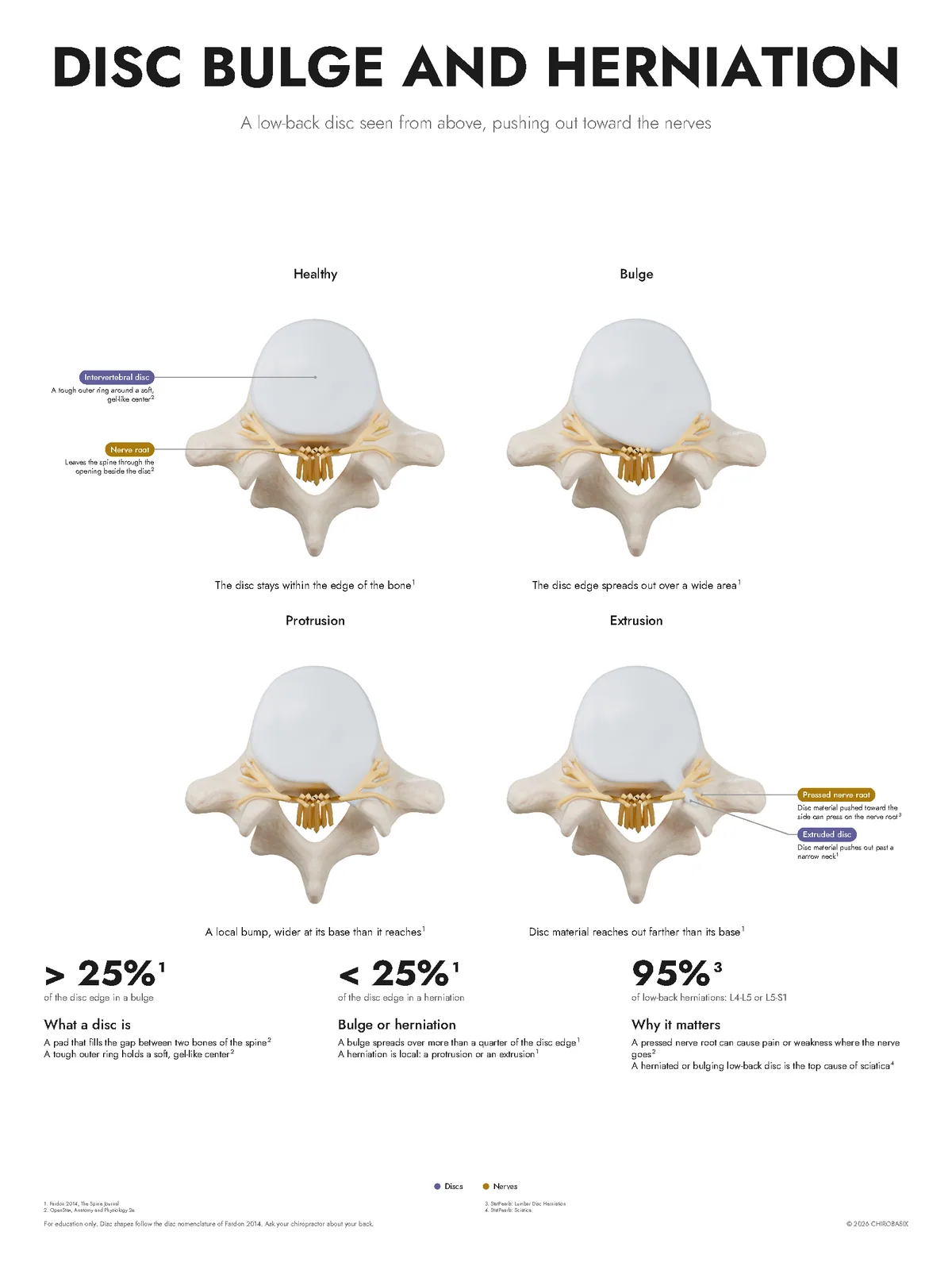
A low-back disc seen from above, pushing out toward the nerves. Stages: Healthy, Bulge, Protrusion, Extrusion.
Side-by-side views and stages that help patients picture what is going on.
What it shows
- Healthy
- Bulge
- Protrusion
- Extrusion
Facts on the poster
- > 25% of the disc edge in a bulge
- < 25% of the disc edge in a herniation
- 95% of low-back herniations: L4-L5 or L5-S1
Printed on the poster: For education only. Disc shapes follow the disc nomenclature of Fardon 2014. Ask your chiropractor about your back.
Print details
- Paper
- Museum-quality matte paper, 200 gsm (80 lb), printed with archival inks.
- Framed
- Ready to hang. Wood frame with a shatterproof acrylic front and the hanging hardware attached. Black, white, natural wood or dark wood.
- Shape
- Tall (portrait)
- Topics
- Spine and Back, Nerves and Brain
Sources (4)
- Fardon DF, Williams AL, Dohring EJ, Murtagh FR, Gabriel Rothman SL, Sze GK. Lumbar disc nomenclature: version 2.0. Spine J 2014;14
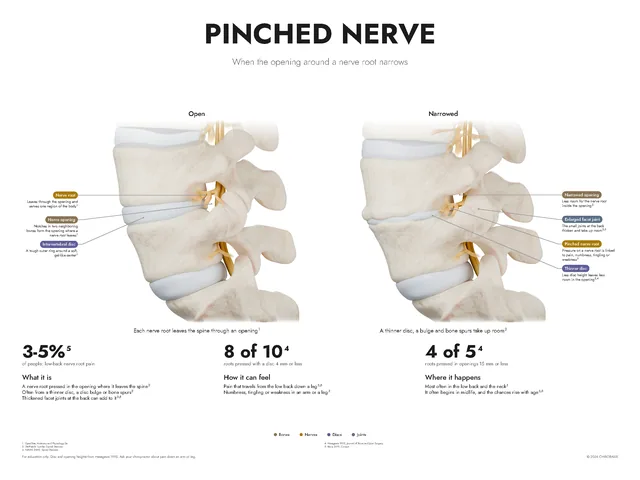
- OpenStax, Anatomy and Physiology 2e, 7.3 The Vertebral Column: an intervertebral disc is a fibrocartilaginous pad that fills the gap between vertebral bodies; the anulus fibrosus is its tough, fibrous outer layer and the nucleus pulposus its softer, gel-like center; posterior bulging of the nucleus pulposus can compress a spinal nerve, causing pain and/or muscle weakness in the regions that nerve supplies; the intervertebral foramen is the opening between vertebrae where a spinal nerve exits; the most common sites of herniation are L4/L5 and L5/S1
- Al Qaraghli MI, De Jesus O. Lumbar Disc Herniation. StatPearls, StatPearls Publishing; last update August 23, 2023. Approximately 95% of lumbar disc herniations occur at L4-L5 or L5-S1; radicular pain arises when disc material presses on or contacts the lumbar nerve roots; due to the proximity of the nerve root, a posterolateral herniation is more likely to compress the nerve root; a lateral herniation at L4-L5 causes L5 radiculopathy
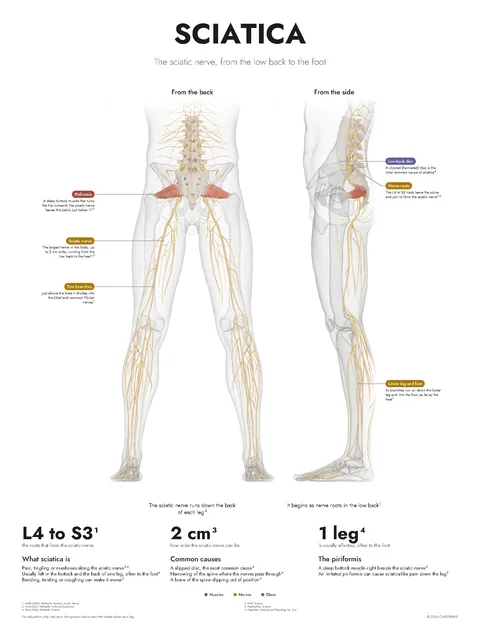
- Davis D, Taqi M, Vasudevan A. Sciatica. StatPearls, StatPearls Publishing; last update January 4, 2024. Sciatica is pain or paresthesias in the sciatic nerve distribution; the most common cause of sciatica is a herniated or bulging lumbar intervertebral disc; the sciatic nerve is made of the L4 through S3 nerve roots