Test store. Nothing is charged: pay with card 4242 4242 4242 4242, any future date, any CVC.
Conditions and Care
Pinched Nerve
When the opening around a nerve root narrows
$59
- Free shipping on 3 or more paper prints. Shipping is added at checkout.
- Printed to order for your office and shipped to US addresses.
About this poster
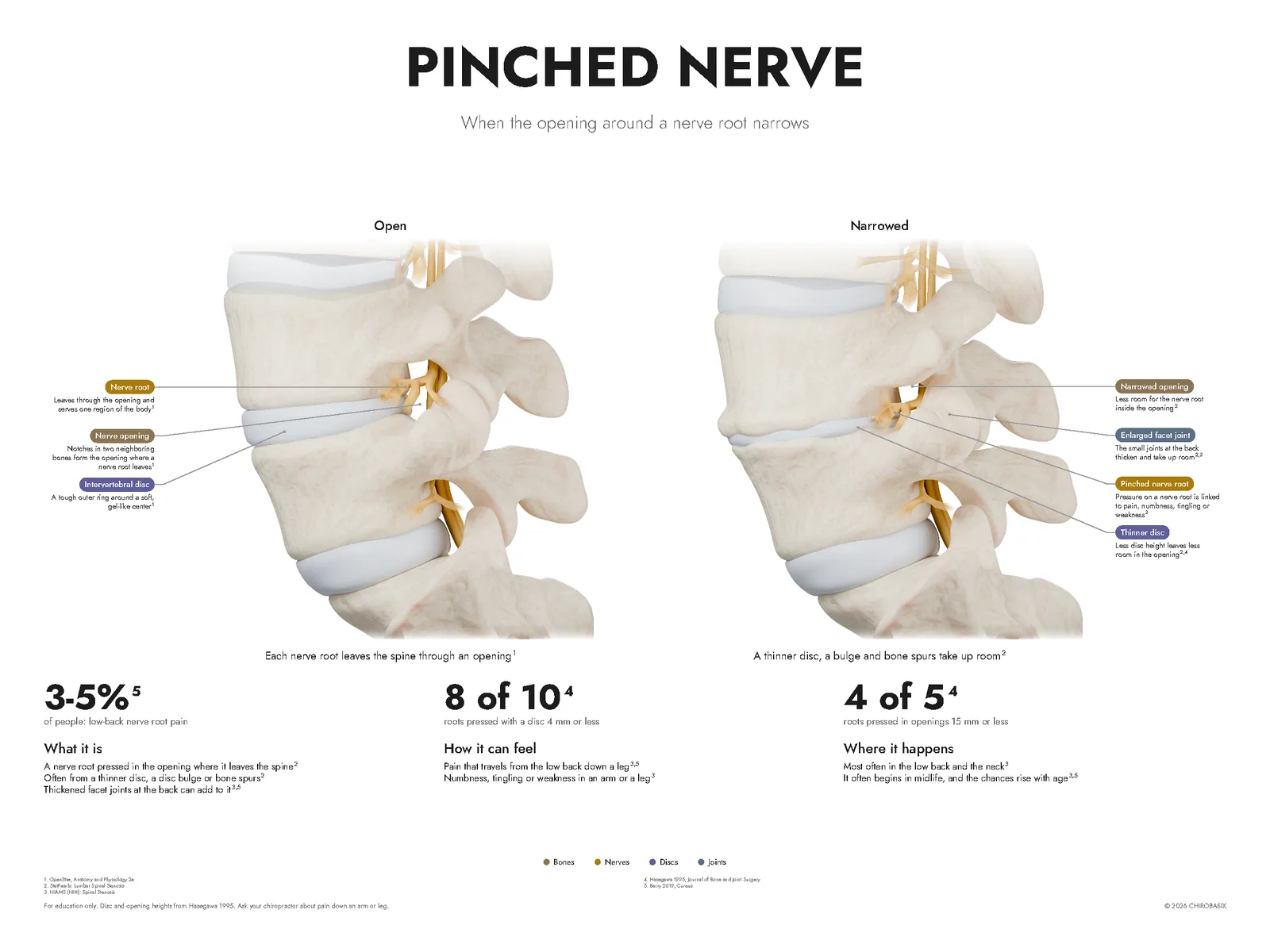
When the opening around a nerve root narrows. Stages: Open, Narrowed.
Side-by-side views and stages that help patients picture what is going on.
What it shows
- Open
- Narrowed
Facts on the poster
- 3-5% of people: low-back nerve root pain
- 8 of 10 roots pressed with a disc 4 mm or less
- 4 of 5 roots pressed in openings 15 mm or less
Printed on the poster: For education only. Disc and opening heights from Hasegawa 1995. Ask your chiropractor about pain down an arm or leg.
Print details
- Paper
- Museum-quality matte paper, 200 gsm (80 lb), printed with archival inks.
- Framed
- Ready to hang. Wood frame with a shatterproof acrylic front and the hanging hardware attached. Black, white, natural wood or dark wood.
- Shape
- Wide (landscape)
- Topics
- Nerves and Brain, Spine and Back
Sources (5)
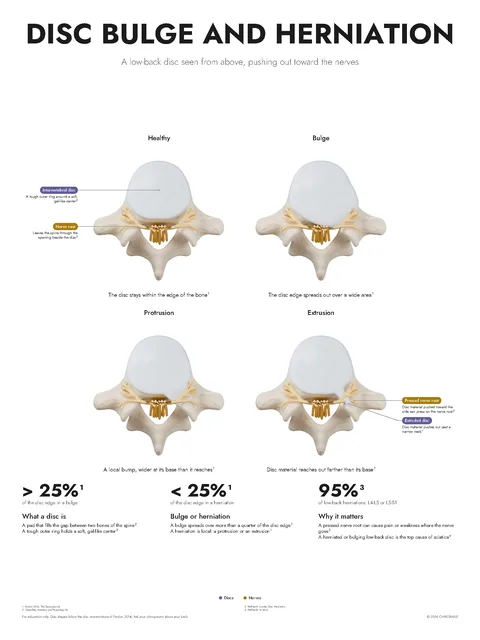
- OpenStax, Anatomy and Physiology 2e, 7.3 The Vertebral Column: notches in the margins of the pedicles of adjacent vertebrae together form an intervertebral foramen, the opening through which a spinal nerve exits the vertebral column; an intervertebral disc is a fibrocartilaginous pad between vertebral bodies, its anulus fibrosus the tough, fibrous outer layer and its nucleus pulposus the softer, gel-like center; a herniated disc can compress a spinal nerve where it exits through the intervertebral foramen, with pain and/or muscle weakness in the body regions supplied by that nerve; with age the nucleus pulposus loses water and the disc becomes thinner
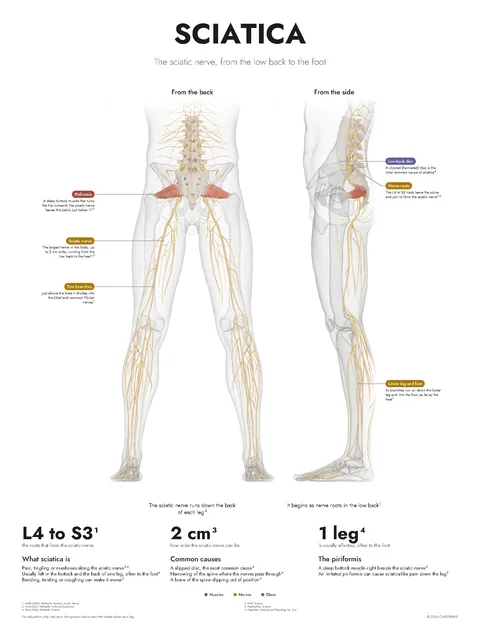
- Munakomi S, Cruz R. Lumbar Spinal Stenosis. StatPearls, StatPearls Publishing; 2024. Lateral recess and neural foraminal stenosis may compress the nerve roots and produce one-sided lumbar radiculopathy symptoms; lateral recess stenosis results from facet arthropathy and osteophyte formation; foraminal stenosis is due to disk height loss, foraminal disk protrusion or osteophyte formation, which impinge on the nerve root inside the intervertebral foramen; the nerve roots exit through the intervertebral canal. Chapter text read through the Europe PMC record
- National Institute of Arthritis and Musculoskeletal and Skin Diseases
- Hasegawa T, An HS, Haughton VM, Nowicki BH. Lumbar foraminal stenosis: critical heights of the intervertebral discs and foramina. A cryomicrotome study in cadavera. J Bone Joint Surg Am 1995;77
- Berry JA, Elia C, Saini HS, Miulli DE. A Review of Lumbar Radiculopathy, Diagnosis, and Treatment. Cureus 2019;11